

Transformer: Principles, Types, and Applications
Transformers are closely associated with the properties of inductors, playing a crucial role in electrical systems. When an inductor with an alternating current (AC) voltage across it is placed in parallel with a second inductor, the electromagnetic field of the first inductor induces an AC voltage in the second one. When these two coils, known as windings, are placed on a core, they form a transformer. The input voltage is applied to the primary winding, and the induced voltage is obtained from the secondary winding.
If the number of turns on the secondary winding is greater than that on the primary winding, the secondary voltage will be higher than the primary voltage. This type of transformer is called a step-up transformer. On the contrary, when the number of turns on the secondary winding is fewer, the voltage is lower, and it is referred to as a step-down transformer.
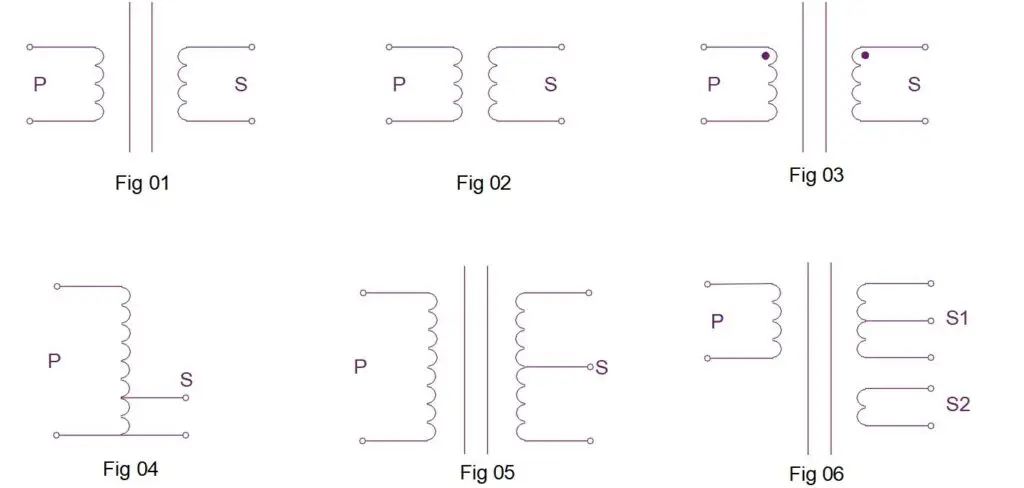
There is a wide variety of transformer configurations. For instance, there are air-core transformers (Fig 01), which are suitable for certain high-frequency applications. Iron-core transformers (Fig. 02) significantly increase the mutual inductance between windings, enhancing the transformer’s efficiency and performance. Phased windings (Fig. 03) are notable because the secondary voltage is 180° out of phase with the primary voltage. An autotransformer has only three leads (Fig. 04), with one being a common connection, providing a cost-effective solution for voltage transformation in some cases. Some transformers feature a center-tapped secondary (Fig. 05) and multiple secondaries (Fig. 06), enabling the generation of various voltages to meet different electrical requirements. Transformers are available in a vast range of voltage ratings, sizes, and shapes to suit diverse applications.
Transformers serve multiple essential functions. They are used to step up or step down voltage in power supplies, ensuring that electrical devices receive the appropriate voltage for operation. They also provide electrical isolation, preventing the flow of direct current (DC) between circuits while allowing AC signals to pass through. Additionally, transformers are employed for impedance matching, optimizing the transfer of power between circuits. Moreover, they are used to couple signals between circuits, facilitating the transmission of electrical signals in various electronic systems.
Typically, direct current (DC) is not effective in a transformer, except when it is varying. Constant DC can saturate the windings, leading to inefficiencies and potential damage. Hence, a transformer is generally regarded as an AC device. Whether you’re exploring electrical engineering concepts, working on power distribution systems, or designing electronic circuits, understanding the principles, types, and applications of transformers is essential for success.

One thought
Played the 898aslotapk today, it was cool, decent graphics and it was easy to pick up. Try it yourself here! 898aslotapk